

chefs
carers
housekeepers
nannies
gardeners
chauffeurs

Pricing
Join Stafftax Payroll & HR from just £276 per year
Our all-in-one Payroll and HR service includes a bespoke employment contract and unlimited employment law advice and support, making it easier than ever to manage your nanny or household staff with confidence.
Add Pensions Service from £89 per year
If your employee is eligible for a pension, you must enrol them into a pension scheme.
Add Stafftax Plus for £17.50 per month
We’ll make the payments to your employee and HMRC on your behalf.
Customer Testimonial
“Similar to many others, we were under pressure to recruit a carer for a parent with early dementia and couldn’t face the paperwork and difficulty of becoming an employer. Finding Stafftax was such a relief! Cost effective, easy to set up, easy to deal with and very comprehensive documentation. We now feel safe and well supported by Stafftax.” – Peter, August 2025
Why we're the best
You can subscribe to Stafftax today from just £276 per year, add the workplace pensions service from £89 per year and Stafftax Plus for an additional £17.50 per month for your first employee.
Call us on 020 3137 4407 seven days a week, or you can click the ‘Subscribe now’ button below.
Stafftax has been trusted by over 3000 domestic employers in the UK over the last 20 years.
01
Deal With HMRC On Your Behalf
That is everything from registering you as an employer, submitting RTI (Real Time Information) returns (a HMRC duty) for you every month, to producing and sending your employee P60 at the end of a tax year.
02
Bespoke Contracts
Stafftax will provide you with a tailored contract, which is created by our specialist HR advisors. We will also give you an employee handbook which explains the employment policies in detail, to help both you and your employee understand and agree to the terms in the contract.
03
Provide Payslips And More
Each month we’ll e-mail you when your payslips are ready to view and download. We also process a P45 every time an employee leaves and provide you with a P60 for your employee at the end of the tax year.
04
Unlimited HR Support
Stafftax HR run a helpline to support you with any legal advice or behavioural queries. You can contact Stafftax HR at any time for no additional fee once you have subscribed. We’ll also provide you with various downloadable factsheets, including holiday request forms to give to your employee to use, all via your Members Area.
05
Online Members Area
Manage your Stafftax account from one place. Our online Members Area will keep a record of all payslips, P60s and other relevant documents. It is where you can make changes to your employee’s salary and tell us when your employee is leaving. Additionally, you can set up your employee with their own members area so that they can view their payslips as and when they need to.
06
Additional Services
We provide additional services to help keep you compliant and make your employment journey as simple as possible. From our complete Workplace Pensions Service where we manage all your employee’s auto enrolment requirements, to our Stafftax Payroll Plus Service where we’ll pay your employee and HMRC on your behalf.
How do I join Stafftax?
We understand you might prefer to talk to someone about employing a domestic worker, discuss our household employee payroll services and answer any queries you may have.
Our friendly team are available to talk 7-days a week, from 8.30am – 7.30pm, Monday to Friday and 10am to 4pm on Saturday and Sunday, on 020 3137 4407.
Alternatively you can get set up with Stafftax straight away by joining us now online.
Online sign up is unavailable for our 3 and 6 month subscriptions.
Our dedicated team look forward to chatting to you about employing a household Employee and answering any queries you may have about any of our services.
Request a call
Complete the short form below to request a call from a Stafftax advisor.
An all-inclusive domestic payroll service for your peace of mind.
Our Domestic Payroll Service makes employing household staff easy and ensures you fulfil your legal obligations as an employer. Plus, it gives you unlimited access to our team of experienced employment experts who will support you through the sometimes confusing areas of HR, such as staff sickness, maternity pay, redundancy, tax rates and holiday entitlements.
Our customers employ a wide range of domestic staff, from PAs, cleaners and carers, to chauffeurs, chefs and stable grooms. Whoever you employ, we are looking forward to helping you.
We Deal With HMRC
Our end-to-end domestic staff PAYE payroll service will take care of all your HMRC responsibilities.
Provide Payslips & More
Each month we’ll e-mail you when your payslips are ready to view and download. We also process P45s every time an employee leaves and provide you with a P60 for your employee at the end of the tax year.
Bespoke Contracts
Stafftax will provide you with a tailored contract, which is created by our specialist HR advisors.
Unlimited HR Support
Stafftax HR run a helpline to support you with any legal advice or behavioural queries. You can contact Stafftax HR at any time for no additional fee once you have subscribed.
Employment Contracts & HR
As part of our Stafftax household payroll services you will receive a free bespoke contract of employment tailored by our CIPD-qualified HR experts. You will also have unlimited access to our team of HR professionals and receive expert advice on your HR related queries.
The Stafftax HR phone lines are open from 9am-5pm, Monday-Friday, and clients can also access a wide range of Stafftax HR resources through the HR section of their Members Area.
FAQs
What is included in the Stafftax Payroll & HR Service?
The Stafftax Payroll & HR service includes everything you may need as a domestic employer. This includes setting up a PAYE scheme, generating payslips (weekly or monthly), preparing a bespoke contract of employment, providing unlimited HR support and support with managing your legal obligations.
Will Stafftax register me as an employer with HMRC and handle PAYE?
Yes, this is an end-to-end PAYE service. Stafftax will take care of your employer registration, monthly RTI submissions, payslips, issue a P60 for the end of the tax year, and complete any paperwork when the employee leaves – known as a P45.
What about pensions, insurance or paying HMRC on my behalf?
Stafftax offers a full workplace pension management (deducting contributions, updating payslips) and other optional add-ons such as employers’ liability insurance and a service called Stafftax Plus, where they pay HMRC and your nanny for you.
Is HR support included, and how does that work?
Yes, unlimited HR support is included for every subscription. Subscribers get access to HR telephone and email support for legal and behavioral queries, a contract of employment and downloadable policies.
When should I sign up and how quickly can I get set up?
You can sign up online for most packages and get set up quickly. For best results, Stafftax recommends signing up 4–6 weeks before your employees start date so the first payslip can be ready on time.
You may also be interested in
Stafftax Payroll Plus
Ease the burden of your monthly payroll obligations with our premium service, Stafftax Plus.
Workplace Pensions Service
Do you have a workplace pension scheme in place? The UK government now requires all employers to offer a pensions scheme and automatically enrol eligible staff into it.
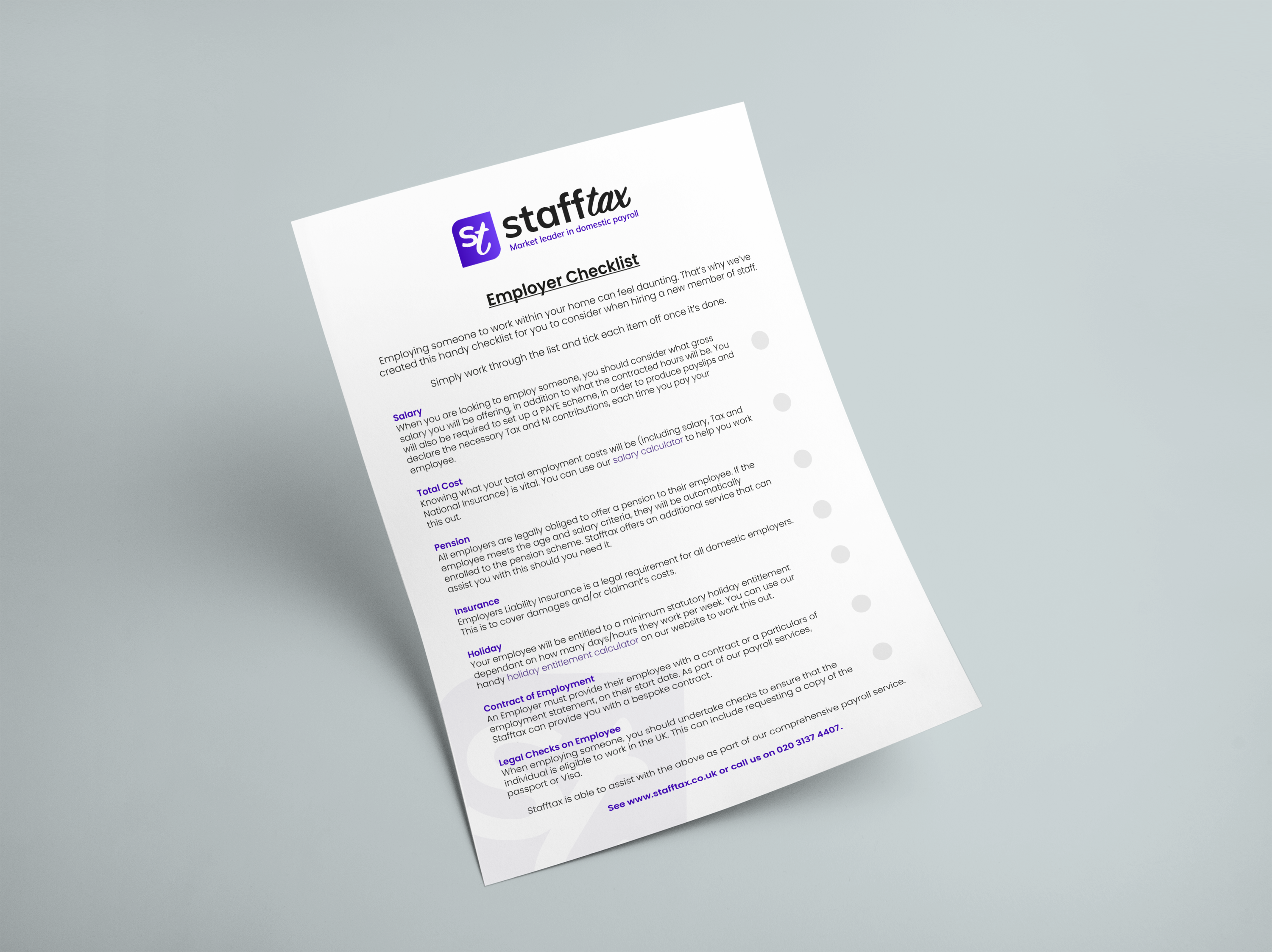
Domestic Employers Checklist
Our handy checklist for you to refer to when hiring your domestic staff.